You can measure PPFD at home with a smartphone app or a handheld quantum sensor. Hold the sensor level at canopy height, take readings across a grid, and average them. Apps are the low-cost route. A dedicated meter is the accurate one. This guide covers both, step by step.
PPFD is the light reaching the plant, in µmol/m²/s. Measure it at leaf height, not at the fixture.
Take 9 to 16 readings in a grid, then average them.
Check the result against your stage: under 100 for seedlings, 100 to 500 for veg, 400 to 1,200 for flower or fruit.
Pair PPFD with hours of light. DLI = PPFD × hours × 0.0036.
PPFD stands for photosynthetic photon flux density. It counts the photons in the 400 to 700 nm range that land on one square meter each second. The unit is µmol/m²/s, as defined in the Virginia Tech DLI guide.
Watts and lumens do not give you this number.
Watts describe power draw, not light on the plant.
Lumens and footcandles describe brightness to the human eye.
PPFD describes light the plant can use.
The University of Kentucky toolkit notes that 1 footcandle is only about 0.13 to 0.2 µmol/m²/s, and the ratio changes with the light source. Converting footcandles to PPFD is a rough guess at .
Your eyes adjust to the light level automatically. A dim tent can look bright after a minute. The same Kentucky guide says growers should use a quantum sensor or a calibrated app instead of judging by brightness. That is the reason to measure at all.
Measure first, then compare with a target. The University of Maine Cooperative Extension lists these ranges for each stage:
These are ranges, not goals to hit at any cost. Species, CO₂, temperature and genetics all change what a plant can use. Higher is not always better. If you are growing a specific crop, check its own range first.
There are three practical ways to measure PPFD at home.
Apps use the phone camera to estimate PPFD. They are the cheapest option.
You must pick the light source type in the app, such as LED or fluorescent. Iowa State Extension explains that the sensor needs to match the light’s color output. Without it, readings are significantly off.
Phone cameras are not built for long-term use in humid, dusty rooms.
Results vary by phone model. Treat them as an estimate and look at trends, not single numbers.
Spectrum matters. Fixtures with unusual colors, such as strong red or added far-red, may read less accurately than plain white LEDs.
A quantum sensor counts photons directly. Michigan State University’s guide says light intensity for plants should be measured with a quantum sensor.
Budget meters have one weakness: directional response. Apogee Instruments’ technical note explains that a meter with poor directional response can be accurate only when held directly under a source. Accuracy drops for light that arrives at an angle. That happens at tent edges and under diffuse light.
Most fixture makers publish a PPFD map at set heights. This is not a measurement of your room. It shows how the light performs in a lab, with no reflective walls and no plants. Then check with your own tool.
The method is the same for apps and meters.
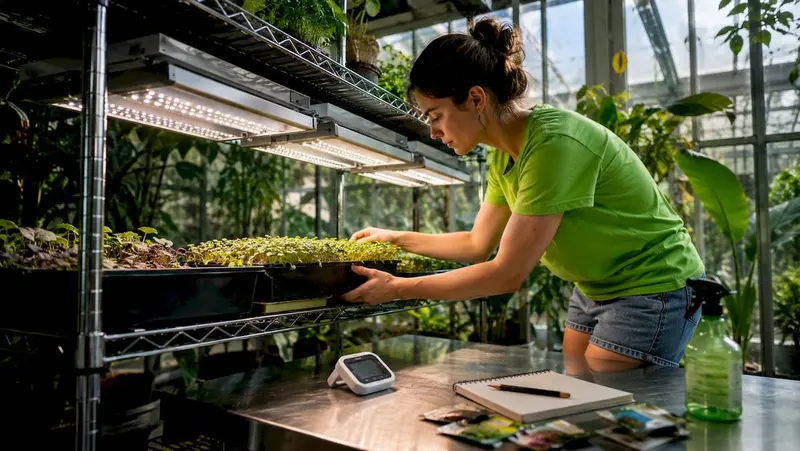
Set up the room as it runs. Close the tent. Use your normal height, dimming level and reflective walls. Turn off other lights.
Warm up the fixture. Let it run 10 to 15 minutes so output is stable. This is standard practice, not a figure from a research source.
Set the app. Choose the correct light type. Skip this step with a meter.
Set the sensor height. Place it at the height of the top leaves. Iowa State Extension warns that readings at the top of a tent or desk height overestimate what reaches the leaves.
Keep it level. Tilting the sensor changes the reading. Use a small bubble level or a flat board.
Take readings in a grid. For a 2×2 ft tent, use at least 9 points. For 4×4 ft, use 16. Record each number.
Average the readings. Add them up and divide by the number of points.
Note the spread. The ratio between them shows how even your light is.
Repeat after changes. Measure again when you change height, dimming, or the number of fixtures.
Say you measure a 2×2 ft grid with nine points:
The total is 4,070. Divided by 9, the average is about 452 µmol/m²/s. The center reads 610 and the corners 360 to 400. For a veg stage, the average sits inside the 100 to 500 range. The center is above it. If plants are stretching or bleaching in the center, raise the light or dim it. If the corners lag, add reflective walls or move plants toward the middle.
This example uses made-up numbers to show the math.
PPFD is a rate. DLI, the daily light integral, is the total a plant receives in a day. The University of Maine publication gives the formula as PPFD × hours of light × 0.0036. The result is in mol/m²/day.
450 PPFD × 18 hours × 0.0036 = 29.16
450 PPFD × 12 hours × 0.0036 = 19.44
800 PPFD × 12 hours × 0.0036 = 34.56
A plant can reach a similar total with lower intensity over more hours or higher intensity over fewer hours.
Measuring at the fixture. Light falls off fast with distance. Always measure at the canopy.
Measuring one spot. The center of a tent often reads far higher than the edges. A single point hides this.
Wrong app setting. The wrong light type gives errors that look believable.
Dirty sensor. Iowa State Extension notes that mineral deposits from misting and dust cause low readings. Wipe the sensor before each session.
Trusting a cheap meter at the edges. Cosine error shows up at angles. Use the center readings with more confidence than the corners.
Ignoring spectrum. Apps tuned for one spectrum can misread another.
Measuring once. Plants grow. Canopy height changes. Re-measure at each stage.
Apogee Instruments and Michigan State University both stress sensor care. Dust, mineral deposits and moisture reduce readings, and sensors left near canopies should be checked to confirm they have not shifted or been covered.
Wipe the sensor with a soft, clean cloth.
Check the manufacturer’s calibration interval for dedicated meters.
Use your averages to decide on a change. Change one thing at a time and measure again.
Too low: lower the fixture, raise the dimmer, or add reflective material.
Too high: raise the fixture or dim it. Watch leaves for stress.
Uneven: adjust height, add a light, or move plants. Under-canopy lighting can help when lower leaves are shaded.
Hang height is the fastest lever. Treat those as starting points and confirm with a reading.
Growers set a height from a chart, then never check what lands on the lower leaves.
How even the light is across the grid.
Whether lower leaves get light at all.
A top light cannot reach shaded lower leaves in a dense canopy. Supplemental light there adds to what the plant can use.
Move to a quantum meter when you run more than one tent or want repeatable readings. Whatever you use, measure in a grid, not at one point.
Mammoth Lighting PAR Meter and Spectrometer for canopy readings.
AC Infinity VPD Thermometer for leaf temperature and VPD.
Top lighting for main canopy coverage.
Under canopy grow lights for lower-leaf light.
Apps use the phone camera to estimate PPFD. Choose the correct light source type in the settings, or the readings will be significantly off. Use the numbers as an estimate and compare readings over time.
How accurate are PPFD apps compared with a meter?
Apps are adequate for standard indoor setups when configured correctly. Quantum sensors are more accurate and more stable over time. Professional growers usually prefer dedicated sensors for long-term monitoring, since phones are not built for humid, dusty rooms.
Hold it level, at the height of the top leaves. Do not measure at the fixture, the top of the tent or desk height. Take readings across a grid and average them.
Can I convert footcandles or lux to PPFD?
Only roughly. One footcandle is about 0.13 to 0.2 µmol/m²/s, and the ratio depends on the light source. Footcandles measure what the eye sees, not what the plant uses. A PPFD reading is better.
Measure after any change to height, dimming or fixtures, and at each growth stage. Plants grow toward the light, so the distance to the canopy keeps changing. Clean the sensor before each session.
University of Maine Cooperative Extension, Growing Houseplants Under Artificial Lights
University of Kentucky, Sensors and Tools for Evaluating CEA Production
Virginia Tech Extension, Calculating and Using Daily Light Integral
Apogee Instruments, Directional Response of Quantum Sensors
Iowa State Extension, Providing Supplemental Light to Indoor Plants
Michigan State University, Proper Use of Light Sensors
Canopy PPFD Uniformity: How to Measure and Improve It
2x4 Tent PPFD: Map 30–40% Edge Loss Before Sizing by Efficacy
70% PPFD Uniformity: Measure First Under Canopy Lighting for Growers
24–36, 12–24, 6–12 inches: Proximity Lighting Distances Set by PPFD

Sorular ve tartışma
Bir sorunuz mu var veya paylaşmak istediğiniz faydalı bir şey mi? Sohbeti başlatın.