Everyone loves the idea of hydroponics: No more dirt, bigger plants, all water. Seriously, what’s not to love?
Choosing the right hydroponic system — that’s what. There are hundreds out there, so it can be overwhelming trying to choose the one for your grow tent or grow room.
This guide is your key to unlocking the potential of hydroponics in your grow room.
For Large-Scale Ebb and Flow Growing
What Are the Advantages of Hydroponics?
What Are the Challenges of Hydroponics?
Advantages of Ebb and Flow Hydroponics
Challenges of Ebb and Flow Hydroponics
Should I Use an Ebb and Flow System?
How Do Deep Water Culture Systems Work?
Advantages of Deep Water Culture Hydroponics
Challenges of Deep Water Culture Hydroponics
Advantages of Drip System Hydroponics
Challenges of Drip System Hydroponics
Advantages of Coco Coir and Perlite
The Right Nutrients for Hydroponic Plants
Step 1: Determine How Often You Want to Water Your Plants
Step 2: Determine the Type of Hydroponic System for Your Watering Needs
Step 3: Determine the Size of Your Hydroponic System
Now, the foundation for any decision — especially in the grow room — is knowledge.
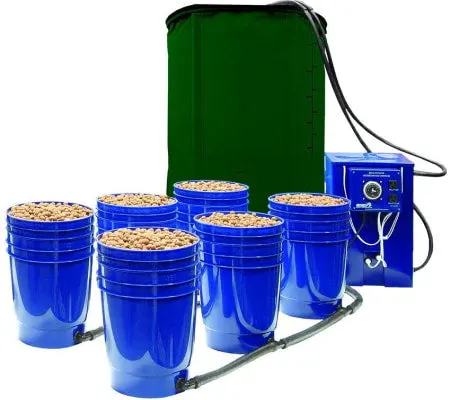
Greentree Hydroponics Multi Flow 6 Site Ebb and Flow Hydroponic System — Grower’s Choice
The beauty of a hydro setup like the Greentree Hydroponics Multi Flow 6 Site Ebb and Flow Hydroponic System is that it’s enough for any grower in any medium-sized growing space (around 4x4ft to 5x5ft).
This hydro system is also modular. That means you can use one or all six of the buckets included with this system.
This hydroponic system has the ability to give you up to heavy yields with up to 6 plants each season. As such, this system’s simple enough to use successfully, whether you’re a novice or you’ve been growing with hydro for some time.
Recommended Medium: Coco and perlite
Recommended Plant Count: Up to 6 flowering plants
Recommended Method of Growing: Ebb and flow
Recommended Growing Area: 4x4ft to 6x6ft
Root Spa 5 Gal 4 DWC Bucket System — For Compact Growing Spaces
If you’re looking for something to give your plants every bit of nutrition they need without taking up a ton of space, the Root Spa 5 Gal 4 DWC Bucket System is the setup for you.
Being a DWC, this bucket system is designed to give your plants nutrition 24/7, so they’ll be able to feed to their fullest potential.
What sets this system apart from others, though, is its modular and compact design. You can connect one or all four of the buckets in this system and keep an eye on your plants. Better, you can tend to (and customize) each plant’s feeding cycle without disturbing the rest of your plants.
Recommended Medium: Clay pebbles; rockwool starter cells can be transplanted into pebbles for full growth
Recommended Plant Count: Up to 4 flowering plants
Recommended Method of Growing: Deep water culture
Recommended Growing Area: 2x4ft to 4x4ft
Root Spa 5 Gal 8 DWC Bucket System — For Large-Scale DWC Growing
When you want individual care for lots of plants, the Root Spa 5 Gal 8 DWC Bucket System is the hydroponic system you’re looking for.
This hydroponic kit has 5-gallon pots and the ability to grow up to 8 plants at a time. All you need with this system is the right nutrients and medium, and your plants will get all-day nutrition.
While you could scale this system down, it’s particularly good for large-scale DWC growing. This is because the larger your plants get, the more space you can give them.
Compared to flood tables and setups where buckets are connected together, this hydroponic system will let your plants grow as much foliage as possible for huge yields.
Recommended Medium: Clay pebbles; rockwool starter cells can be used in pebbles when transitioning clones/seedlings into large buckets
Recommended Plant Count: Up to 8 plants
Recommended Growing Area: 5x5ft to 6x6ft
Greentree Hydroponics Multi Flow 12 Site Ebb and Flow Hydroponic System — For Large-Scale Ebb and Flow Growing
If you’re looking for a powerhouse of yields, you’re going to want the Greentree Hydroponics Multi Flow 12 Site Ebb and Flow Hydroponic System.
With this system, you can grow up to 12 plants. Making things even better, the huge 60-gallon reservoir included can provide nutrition for even more plants.
The key factor that makes this system so effective for large-scale ebb and flow growing is its flexibility. This hydroponic system can be scaled as large as you can think of with additional sites (i.e., buckets) and a little extra tubing.
When you want to focus on a smaller number of plants, just remove as many sites as you need and you’re ready to grow. So while this hydroponic ebb and flow system is great for growing on a large scale, it’s versatile enough to allow you to put together smaller grows, too.
Recommended Plant Count: Up to 12 plants; additional sites for expansion available
Recommended Growing Area: 6x6ft and larger
Root Spa 5 Gal DWC Bucket System — For Single Plant Growing
When your dream is to grow a single plant you can give all your attention to, the Root Spa 5 Gal DWC Bucket System is the system for you.
This single-bucket hydroponic system is simple to set up, easy to use, and will have you harvesting a great yield off of a single plant.
Its DWC abilities allow your plant to receive water 24 hours a day, 7 days a week without stopping. That means with the right amount of nutrition, your one plant can give you big yields each season.
Better yet, when you’re ready to expand your grow, just set up a second bucket, connect it to your bubbler, and you’re on your way to heavier yields!
By definition, hydroponics is a method of growing plants by using only nutrient-rich water. Compared to soil growing where nutrients are released by soil when watered, hydroponic-grown plants don’t wait for a medium to release nutrition. But that’s not the only thing that puts them at an advantage over soil grown plants.
When it comes down to it, the key difference between soil-free growing and growing with dirt is nutrient uptake.
In Soil, Roots Search for Water — When soil is watered, the nutrients in the soil become available for roots to soak in. When water and soil dries out, nutrients are held in by soil and root intake stops until it’s watered again. In turn, this results in some nutrition being held back altogether.
In Hydroponics, Roots Get Water Directly — When hydroponic plants are watered, nutrient-rich water is given directly for roots to soak in. Even in coco and rockwool, where minimal water is retained, all nutrition is available to your plants right away. This results in much more nutrition than soil.
So in a sense, soil plants have to work harder to get less nutrition than hydroponic plants.
The key to what gives hydroponics the edge over soil-grown plants is the ability to quickly deliver nutrition to your plants. Soil-grown plants tend to hold a number of nutrients back, so when you grow with hydro, you’ll see some great benefits.
Larger Plants — The water used in hydroponics contains a higher concentration of nutrients than most soil. That means your plants get many more nutrients than they would otherwise, which helps build a big, healthy plant.
Faster Growth — In hydroponics, plants are watered at a faster rate than soil. That means their nutrition is not only higher in concentration, but it’s delivered to roots faster, too. That increases the rate of growth.
In soil, your plants receive as many nutrients as the medium will allow. Soil’s slow to release nutrients, so even when you add more nutrients to soil, it may take a while for your plants to receive them. Worse, it’s easy to overdo it with nutrients in soil, and difficult to fix quickly.
As you can see, hydroponics offers some great advantages for your indoor grow tent or grow room. But that’s not to say hydroponics is free of any difficulties. In fact, there are a few key challenges you’re going to face growing soil-free.
Nutrient Burn — If you mix too much of a certain nutrient in your water, you’ll end up “burning” the leaves of your plant because it’s unable to process the excess nutrients. Leaves will start to brown and die out, indicating much bigger issues at the root level that’ll lead to hindered or even halted growth.
So while you shouldn’t go chasing pH and PPM in your garden, be aware that the pH and PPM of hydroponic plants can be altered in both positive and negative ways.
So now that you have an idea of what hydroponics will do for your garden, it’s time to start talking about the different types of hydroponic systems out there. While they all depend on virtually the same things (water, nutrients, and oxygen), each offer their own benefits and challenges.
What makes ebb and flow systems popular in the hydroponic game is their simplicity and effectiveness. Especially when used with coco coir and perlite, these systems offer a similar feel to watering your plants in soil, only automated.
Just like with soil, all you have to do when using an ebb and flow system is figure out the right feeding and nutrient plan for huge harvests.
Ebb and flow systems use a flood-and-drain style of delivering nutrients to your plants. The process goes like this:
Nutrient-rich water is pulled from a reservoir and is pumped to your plants.
The water floods your plant’s roots, and your roots soak in nutrients for a predetermined amount of time. This is how your roots get nutrients.
After that time, that water is drained back into the reservoir, and your plants’ roots are allowed to receive the oxygen they need to sufficiently take in those nutrients. This is how your plants receive oxygen.
Once it’s time to flood your plants again, the process starts all over. You repeat this as many times as your plants need in order to receive all the nutrition they’re looking for.
Ebb and flow is probably the most common way to grow hydroponically for a few reasons.
Air Pruning for Larger Yields — Air pruning allows roots to die off and create new root systems, which in turn grow much bigger plants and yields. Ebb and flow systems are one of the only hydro setups that naturally air prune roots, whether you’re growing in buckets or on a flood table.

Pytania i dyskusja
Masz pytanie lub chcesz się czymś podzielić? Rozpocznij rozmowę.