First, calculate the ratio of nutrients to the amount of water your feeding chart recommends (i.e. find out how many nutrients you should put into a given amount of water).
To do this, just look at your feeding chart and see how many gallons of water the nutrients are measured after. For example, if the chart says "Per 1.5 Gallons of Water" then however many mL of nutrients you use is measured per 1.5gal of water.
Then calculate the amount of water you plan on using in your feeding reservoir
Take the number of nutrients you're supposed to use per gallon and divide it by 50%. These plants will remain smaller, so you don't want to give them the same amount of nutrients you'd give a much bigger plant.
Note: if plants start to show signs of burn, scale the nutrients to 75% of the recommended scale and go up from there (plants will require more nutrients in the latter part of its life, so be sure to keep an eye on your plants of nutrient deficiencies later on)
Grow Tents offer the most advantages. They usually have vent ports for intake and exhaust fans, fresh air intake at the bottom of the tent, and reflective material around them. They’re great for keeping bugs out while being able to keep fresh air in.
Challenges: The only disadvantage to a tent is that if you’re going for discreet growing, it’s pretty hard to hide a tent. You either have to downgrade to a very small tent or put your tent in a closet (which sort of defeats the purpose of using a tent, doesn’t it?)
Closet micro grows are great for growers looking to simply open a door and BOOM, they’re entire grow is there. The convenient thing about starting a closet grow is that it can be easier to set up than a grow tent. All you need is some reflective material, your grow light, and some fans to keep your plants growing strong.
Challenges: There are two disadvantages to using a closet for your grow, the first being pretty obvious: bugs. If you thought ants were the only thing that you had in your house, just wait until you start growing- that’s when pests you don’t even know existed come around.
The second disadvantage would be with odors. You may be using filters and duct fans to move air around, but even the filters cannot mask the smell of a bare plant, and if you’re growing in your closet there’s lots of potential for air leaks. That air that leaks out will more than likely have the aroma of your garden, which may be fine for you, but maybe not so much to your neighbors or fellow housemates.
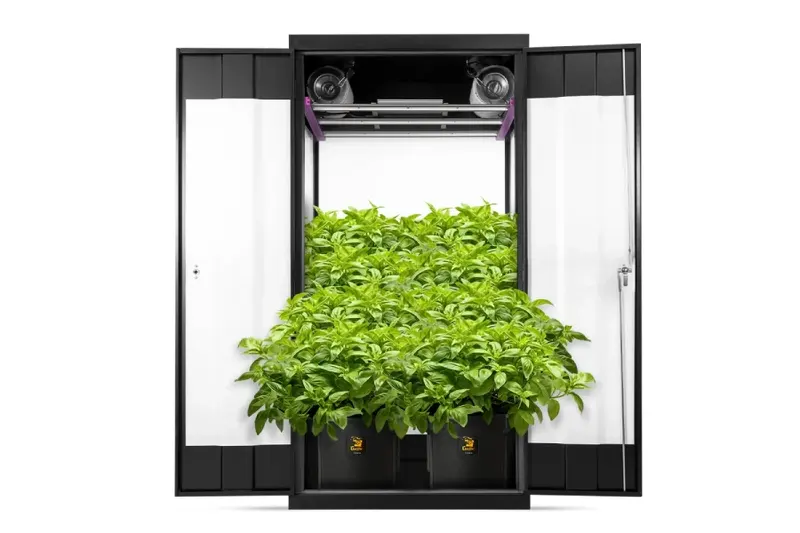
Grow boxes are a great way to hide your grow in plain sight. These are for those growers looking to grow without taking up any more space in their home or apartment than, say, a dresser drawer or an entertainment console.
The great thing about grow boxes is the fact that they’re so discreet.
Challenges: Ventilation. Sure, you can use fans and ducting to cool your lights, but what about air intake? Fresh air can be introduced by opening the door of the grow box, but that lets odors out and invites pests, dust, and mold spores from the surrounding area in.
Airflow is vital to your grow, because without it, plants don’t get fresh air, and all of the air that’s in your air will become stagnant. Depending on the style of micro grow you end up using, make sure that all air intake doesn’t allow bugs to come in. If you’re growing in a grow box that might mean building an intake/exhaust port with a microfilter to keep pests out
Blade fans and lower-powered duct fans are great to keep air moving in your grow. If you have a duct fan but it’s just too powerful for a small area, you can use a speed controller to slow that airflow down to not hurt your plants.
Filtration is important not only for the smell of your plants but for getting dust and mold out of your growing space.
Without a filter, your air is blowing into an open room. That means not only is your room (or entire home/apartment) is going to smell like your grow, but all of that “fresh” air you want is full of that bad stuff you were just trying to get out.
Soil is not only the most forgiving when growing only one or two plants, but it’s easy to maintain and is more likely to avoid getting diseases such as root rot or being affected too heavily with nutrient lock. However, it’s trickier to get a watering cycle down, as you’ll need to constantly be checking your soil’s water content to assure proper feeding.
Single DWC or Drip buckets are great to use because you pretty much let them run themselves. You check in on them to make sure they’re not wilting from overfeeding, make sure their pH levels are on point and watch the height.

질문 및 토론
궁금한 점이 있거나 유용한 정보를 공유하고 싶으신가요? 대화를 시작해 보세요.