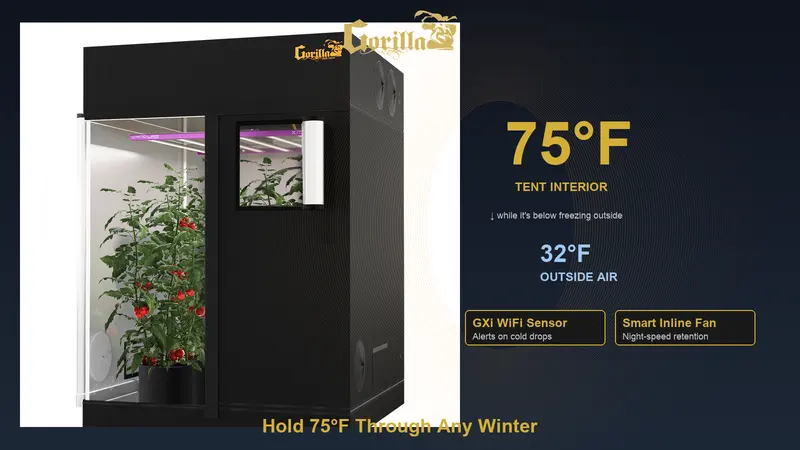
To keep your grow tent warm in winter: (1) use a thick-canvas tent (1680D) that insulates naturally, (2) run your LED during the coldest part of the day (LEDs radiate 20–40W of heat per 100W), (3) add a ceramic space heater or seedling heat mat for passive boost, (4) seal all ducting and door gaps, and (5) reduce exhaust fan speed at night to retain heat.
Target: 70–80°F day, 60–70°F night. Below 60°F, photosynthesis drops by 50%, growth stalls, and roots become susceptible to disease.
Cold is the #1 silent killer of winter indoor gardens. Unlike heat stress — which shows obvious wilting — cold stress creeps in as stalled growth, pale leaves, and a harvest that never quite ripens. The good news: a well-sealed grow tent with the right heat strategy holds 70°F+ through the coldest nights in a 55°F basement or uninsulated garage. This guide covers every realistic way to keep a grow tent warm, what temperature ranges matter for different plants, and which heating method fits your budget and setup.
Optimal Temperature Targets by Plant
Every plant process — photosynthesis, nutrient uptake, transpiration, cell division — runs on enzymes, and enzymes work within specific temperature windows. Below 60°F (15°C), enzyme activity drops by 40–60%. Plants do not die from cold; they stop growing, which in a 12-week cycle means a missed harvest.
Below 55°F: metabolism crawls, nutrient lockout, root disease risk rises sharply
55–65°F: growth slows by 30–50%, pale leaves, delayed flowering
65–75°F: optimal for most plants — full enzyme activity
75–85°F: peak photosynthesis for fruiting plants
Above 85°F: heat stress begins; above 90°F pollen sterilizes in flowering plants
A 1680D canvas grow tent insulates 40–60% better than 600D budget tents.
Every 100W of LED radiates 20–40W as heat. A 420W LED in a 4x4 tent adds 10–20°F over ambient room temp. Run the LED during your coldest hours (typically overnight to morning) to passively warm the tent.
200–500W ceramic heater with built-in thermostat. Place outside the tent pointing at the intake vent, not inside — avoids fire risk with canvas. Digital models with temp control prevent overshooting.
Quieter than ceramic, more even heat, no sudden on/off cycles. Uses more watts but distributes heat gently. for tents in unheated garages or outbuildings.
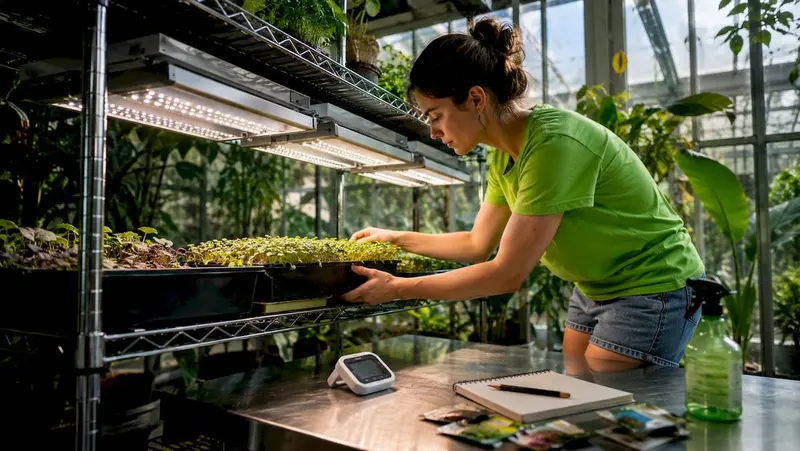
Warms the root zone directly — solves the #1 cold-tent problem (nutrient lockout) without heating the whole air volume. Ideal for seedlings and microgreens.
Cut exhaust fan speed by 50–70% during lights-off. Your tent does not need full air exchange at night (no LED heat to vent). Less air pulled out = warmer tent. A smart inline fan does this automatically.
Heat escapes through unused ducting ports, open zippers, and loose drawstrings. Every exposed port loses ~2°F per hour in a 55°F room. Stuff unused ports with foam blocks or the tent's included port covers.
Open-flame, propane, and kerosene heaters release CO and CO₂ (combustion byproducts) inside a sealed tent. CO poisons plants and humans. CO₂ spikes can be useful but not from combustion — use a proper CO₂ tank + regulator if supplementing.
Close and cinch unused ports. If you see light through a port with the tent closed, it is leaking heat.
The tent zipper should run completely to the top. A double-cinching door gasket (included on Gorilla Pro models) seals better than single-cinching budget tents.
Place the tent on a 2" wooden pallet or rubber mat if your floor is concrete. Cold floors conduct heat directly out of the tent base.
For extreme cold (unheated garages), drape a Mylar or reflective emergency blanket over the tent's exterior — cuts radiant heat loss by 30–40%.
A 62°F interior room beats a 45°F garage — even with the same heater, the tent holds temp with less energy. Pick the warmest spot in your home.
Plants need a night temperature drop — typically 5–10°F below day — to trigger proper respiration and hormone cycles. The problem is keeping the drop controlled rather than freefalling into cold stress.
Day (lights on): LED provides most of the heat. Heater idle or low.
Transition (lights off → cooldown): Tent naturally drops 5–10°F within 30 minutes. This is healthy.
Night (steady state): Target 10°F below day temperature. Heater kicks on if tent drops below the night floor.
Morning (lights on): LED warms tent back up within 30–45 minutes.
Ideal day/night swing is 8–12°F. Tighter (under 5°F) and plants grow stretchy. Wider (over 15°F) and you hit condensation + flower stress. Thermostatic heaters paired with timer-controlled LEDs keep the swing in this sweet spot automatically.
A single thermometer inside a tent gives you one data point. Winter growing requires continuous monitoring because temps swing most dramatically overnight when you are asleep. The GXi WiFi Temp & Humidity Sensor pushes alerts to your phone if the tent drops below your night-floor, and logs 30 days of data so you can spot recurring cold patterns.
Pair temperature with VPD tracking — cold tents often have high humidity (reduced transpiration), which invites fungal disease.
70–80°F during lights-on, 60–70°F during lights-off for most plants. Tropical plants and fruiting vegetables prefer the warm end (75–85°F day). Seedlings do at 70–78°F with a 60–70°F night floor.
What is the easiest way to heat a grow tent?
Run your LED during the coldest hours of the day. A 420W LED in a 4x4 tent adds 10–20°F over ambient room temperature passively. Combine with a 1680D canvas tent for natural insulation before adding a heater.
Can I put a space heater inside my grow tent?
Never place a heater inside the tent pointing at canvas — fire risk. Place it outside the tent pointing at the intake vent, or mount ceramic infrared panels on tent-safe brackets with proper clearance.
What temperature is too cold for a grow tent?
Below 60°F, plant metabolism drops significantly. Below 55°F, growth stalls and roots are susceptible to disease. Below 50°F, most common crops stop growing entirely. Fruiting plants abort flowers below 55°F at night.
How cold is too cold for tomatoes indoors?
Tomatoes stop setting fruit when night temperatures drop below 55°F. Optimal is 65–72°F night.
Does a grow tent keep plants warmer than an open rack?
A sealed canvas tent with reflective interior traps LED heat, while an open rack loses most of it to the room. Well-sealed 1680D tents hold 8–15°F above ambient room temperature with just LED heat.
Should I reduce exhaust fan speed at night?
Cut fan speed by 50–70% during lights-off. Your tent does not need full air exchange at night (no LED heat to vent), and lower fan speed retains heat without compromising plant health.
Can I use a heat mat to warm a grow tent?
A heat mat warms the root zone, not the tent air. It solves the most common winter problem (cold roots causing nutrient lockout) without the cost of heating the full air volume. Ideal for seedlings and microgreens.
What humidity goes with warm tent temps?
Target 50–60% RH with tent temps in the 70–80°F range. Use the VPD chart to dial in the right combo for each growth stage.
How do I stop my grow tent from getting cold at night?
Three-step strategy: (1) schedule LED during the coldest hours, (2) reduce exhaust fan speed at lights-off, (3) add a thermostatic ceramic heater outside the tent set to your night floor. Monitor with a WiFi sensor that alerts on drops.
Winter growing reads: VPD Chart · Leggy Seedlings Fix · Indoor Herb Garden · Using Grow Lights for Tomatoes · Where Indoor Plants Grow Naturally
Hold 75°F Through a Minnesota Winter

질문 및 토론
궁금한 점이 있거나 유용한 정보를 공유하고 싶으신가요? 대화를 시작해 보세요.