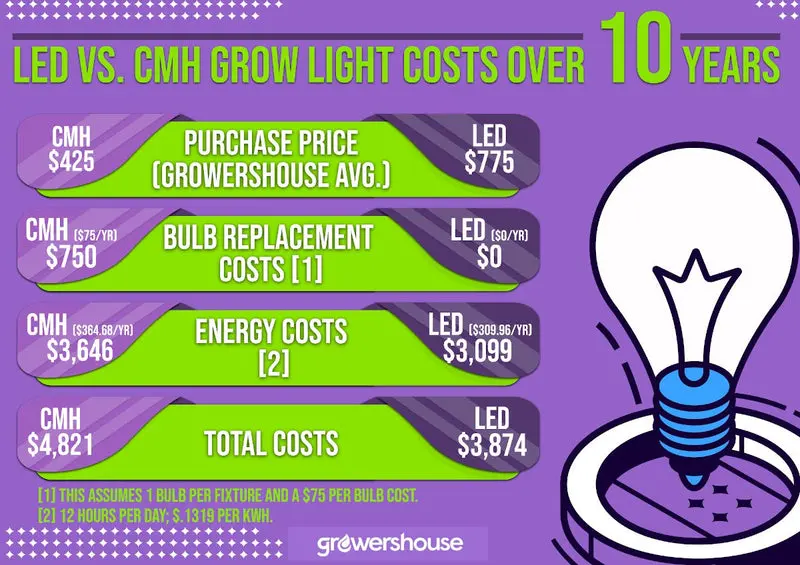
LED grow lights are a bargain in the long run compared with ceramic metal halide lights and fixtures.
Over the long haul, you will have saved money with LEDs as opposed to CMH lights.
Costs aren't everything; lights have to be effective. Both LED and CMH grow lights are effective for every phase of your plants' life.Typically with LED fixtures, you can adjust the light spectrum your plants are getting, increasing blues and/or reds for flowering and budding. With a CMH grow light, you must replace the bulbs for more blue or red, adding cost. But CMH lights are famous for strong harvests with big flowers and heavy, full buds.
Look at all the factors, then decide which light is right for you.
Do LED lights cost more than CMH lights?
Do LED grow lights help you save on energy? Spending less on energy by using LEDs instead of CMH lights comes in two ways:
LEDs give off more usable light at similar or lower wattage, saving 15 percent on average.
LEDs emit less heat, so the cost of air conditioning, air flow and dehumidification can be lower, with results varying by location.
Potentially the electrical bill savings could be even higher. That's because LEDs tend to generate a higher PPF per watt, so a lower-wattage LED could replace a higher wattage CMH with equal or better results in growing and flowering. One lighting manufacturer, for example, got a usable PPF output of 530 from a 241-watt LED versus 439 usable PPFs from a 340-watt CMH.
Additional savings on electrical costs are difficult to quantify because of variables, but that same manufacturer found that its LED fixture, while emitting more usable light, cast off only 20 percent as much heat as the CMH did. A scientific study in California by the Emerging Technologies Coordinating Council found that using LED fixtures versus HPS lights, which burn hotter than CMH bulbs, saved 2 percent on a/c and dehumidifying costs. So, the potential exists for saving on temperature and humidity control with LED instead of CMH, perhaps just not as much as compared with HPS.
Don't doubt that LEDs can generate higher PPFs on fewer watts. In the ETCC study, two crops under LED fixtures actually suffered poor starts from burns because the grower underestimated the additional PPFs coming from the LED fixtures. With another grower, however, crop results under LEDs were normal or better with a 35 percent savings in fixture electrical costs and a 2 percent savings in a/c and dehumidifying costs.
CMH lighting requires frequent bulb replacements and changes:
Annual replacement of the CMH bulb, or two if you have a dual fixture.
Replacement of 4100K CMH bulbs used in the vegetative phase with 3100K CMH bulbs for flowering, then back to the original 4100K.
CMH bulbs typically are replaced every year, not because they no longer light up but because they emit significantly fewer usable PPFs after a year—probably 10 percent less. They generally are rated to have a 20,000-hour lifespan, but at that point their light output would have degraded perhaps 40 percent or more—about 10 percent a year.
LEDs are clearly the winner on replacement costs. LEDs do not require an annual replacement. These low-heat lights are considered to have a lifespan of 50,000 to 100,000 hours. If you burn LEDs 12 hours a day for a year, that's 4,380 hours. At that rate, a light that lasts 50,000 hours would function for 11 years. Because the spectrum on LEDs is adjustable, substitute bulbs for flowering aren't necessary, either.
The light emitted by LEDs degrades a fraction as fast as the light from a CMH bulb. Expect LEDs to lose about 1.4 percent of their effectiveness each year. So, after 10 years, your LED fixture should be emitting 86 percent of its original light level—giving more of its original light than a CMH bulb would after just two years. Most quality LED fixtures are warranted for five years, so your maintenance costs are likely to be nil for that time. Can LEDs or drivers go bad? Of course, but LEDs have undergone decades of development, even though LED grow lights are relatively new. The simplicity of LEDs helps make them ultra-reliable.
You may want to hold onto an old MH or HPS fixture or two in case an LED does need repairs, which probably would require you to ship the fixture for repairs. You could use an old fixture while the LED light is being repaired. The only problem is that, for now, such fixtures cost even more than other LED lamps.
The evidence says LEDs are cheaper than CMH the longer you keep them. But all budgets vary, and if yours says go for cheap but effective to start, CMH lamps will cost you less up front.

Questions & discussion
Have a question or something useful to share? Start the conversation.