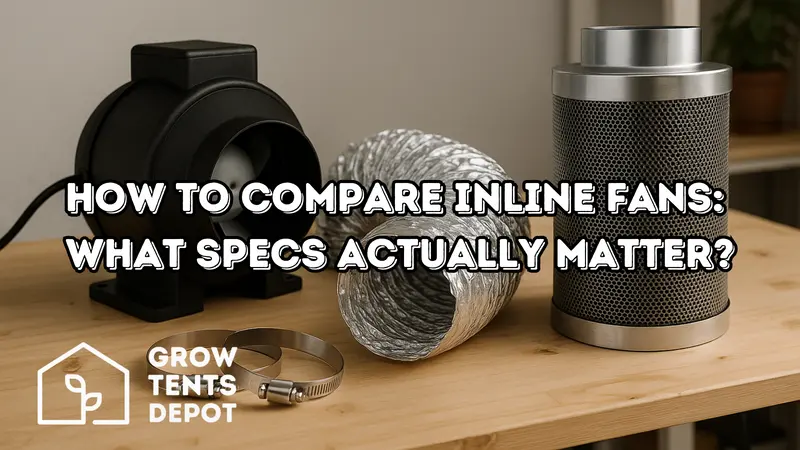
Airflow is one of the most important factors in maintaining a healthy grow tent. Inline fans control temperature, humidity, and odor, but choosing the right one can feel overwhelming if you are new to indoor gardening. Many fans list technical specs that may look confusing at first glance. The good news is that once you understand what each spec means, comparing inline fans becomes straightforward.
What it means: CFM tells you how much air the fan can move in one minute. For example, a fan rated at 200 CFM can move 200 cubic feet of air per minute.
Why it matters: Your grow tent’s total volume should guide your choice.
Tip: Look for a fan with a slightly higher CFM than your tent’s volume to account for resistance from filters and ducting.
What it means: Inline fans are designed to fit ducting of a specific diameter, usually 4, 6, or 8 inches.
Why it matters: Your tent’s ports and your ventilation system need to match the fan’s duct size. Using mismatched sizes can reduce efficiency and increase noise.
Tip: Check your tent’s specs before buying. Most small tents use 4-inch fans, while medium and larger tents benefit from 6- or 8-inch fans.
What it means: Measured in decibels (dB), noise level indicates how loud the fan will be when running.
Why it matters: Grow tents are often placed in bedrooms, apartments, or shared spaces. A noisy fan can become a constant irritation.
Tip: Inline fans with insulated housings or advanced blade designs often run more quietly. Look for models that list noise levels under 50 dB for quieter grows.
What it means: This describes how much power the fan consumes relative to the airflow it delivers.
Why it matters: Efficient fans save money on energy bills and run cooler, which can extend their lifespan.
Tip: EC (electronically commutated) motors are more efficient than traditional AC motors. They often allow variable speed control with less energy use.
What it means: The materials and design of the fan, including bearings, blades, and housing.
Why it matters: A well-built fan will last longer and maintain consistent performance. Cheaper fans may wear out quickly or struggle when paired with filters.
What it means: Some modern inline fans include digital controllers, humidity and temperature sensors, or app-based control.
Why it matters: Automation makes it easier to maintain a stable grow environment without constant adjustments.
Tip: If you are just starting out, simple speed control may be enough. As you gain experience, smart controls can give you more precision and convenience.
Choosing an inline fan comes down to matching the right specs to your grow tent’s size and your growing goals. Focus on CFM, duct size, noise, and build quality first. Energy efficiency and smart controls are valuable extras that can make your setup more effective and easier to manage.



Questions & discussion
Have a question or something useful to share? Start the conversation.