If you’re reading this, that means you’re ready to start growing your own veggies, fruit, and flowers, and that's huge!
Mediums, nutrients, temperatures, pest control, lighting schedules and much more. Think you're up for it?
All you need is a little guidance and you're on your way to becoming the grower you always knew you could be, getting big yields in no time.
"Are you sure I can grow plants indoors?"
Of course, and then some! This guide is for flowering and fruiting crops, and thankfully that covers the vast majority of plants.
So if you need to know everything you need to know about growing flowering and fruiting plants, how to harvest them, and how to keep stock all year long, this is the guide's your key to unlocking big time yields.
Choosing Your Grow Tent, Grow Room, or Greenhouse
Starting Your Grow from Seeds & Clones
What is the vegetative stage of growth?
What is the flowering stage of growth?
There's more to preparation than just clearing a space in your home or apartment to set up a grow room or grow tent. Much more.
From figuring out what kind of grow lights you're going to use to finding the right plant for your setup, prepping each grow is vital to your garden's success.
Choosing the plant you want to grow is the first thing you should think of before starting. As you've heard- and will probably hear a lot in this guide- all plants are different and will require different growing environments.
For example, ornamental flowers like roses need slightly higher temperatures than fruiting plants like orange trees do. They also require different humidity levels to survive, so keep in mind that different types of plants will require their own growing environments, nutrition, and training methods to give you the yield you're after.
Not sure what to look for? No problem. Here are some key aspects you should think of when looking for the strain for your grow:
Garden size- If you know the full-grown size of the strain you want to grow you'll get an idea of how big of an area you'll need to use.
Lighting- It's important to know how big your plant will be so you can figure out how strong your lights need to be. Too strong of a light and your plants will fry, too weak of a light and your plant won't grow. Depending on plant size and count you'll be able to calculate how many lights you need and how to position them in your grow.
Will the harvest consist of big or small produce? The bigger the flower, fruit, or veggie, the more nutrition and lighting your plants need.
How much should you expect to yield? If you're expecting huge yields out of plants that don't traditionally put out big yields you might be disappointed. Make sure you get the strain that gives you a yield you want.
Long day plant vs Short day plants- Short day plants (SDP's) require a good amount of darkness and short periods of light. Long day plants (LDP's) want long periods of light and short periods of darkness.
Ornamental flowers have a limited time their pedals will stay at their most colorful before they die off.
The pedals on a fruiting plant's flowers will eventually shrivel and die as fruit swells. This flowering period lets you know your fruit will start to take shape.
In the case of lettuce, by the time it bears flowers it won't be of much use to you.
No matter what plant you're growing, it's important to understand how long it will take to flower, whether or not you want it to flower, and in the case of fruiting plants, how long from the time a flowering it will be until fruit appears. This will have an impact on how much light and energy you use, as well as the amount of nutrition and the types of nutrition you give your plants.
Choosing genetics isn't only about the species of plant you get. It also involves what state you receive those genetics in, and there are two main ways to start plant life: seeds and clones.
Seeds are the source of all genetics- Whether you want to create your own strain or you want to hone in on the traits of a particular strain, you'll need to breed your plants. While seeds aren't 100% necessary to start growing, they are vital in breeding and enhancing strains.
Growing from seeds can often lead to more resilient plants- Keep in mind that a clone's job is to grow an entire plant from one leaf/clipping. Clones start off from a place of restoration, which can be taxing for the wrong clipping. Starting from a seed and keeping them well maintained usually results in stronger plants than clones.
Clones- Clones will get you up and running quickly. That's why you usually see growers opt for clones over seeds, because while seeds might give you a stronger plant, seeds can't tell you the sex of the plant until it's too late. That's not all:
With clones there's no need to pop seeds and possibly waste them.
Clones are already on their way toward a full grown plant and are identical to the plant it's cloned from, so you'll know the sex is what you need it to be ever time.
Clones are for growers who would like a quick turn-around. Popping seeds and then growing seedlings can be tricky, and while raising clones can also be tricky, rooting clones can be done pretty quickly. Hands down, if you want to grow right away consider finding or taking clones.
Choosing Your Grow Tent/Grow Room/Green House
Once you've figured out the type of plant you're looking to grow and how you want to start your garden, the next thing you'll want to look in to is where you're going to house your plants.
Want to build a green house? Do you want to plant straight in the ground outside, or do you want to convert a room in your home or apartment?
These are the questions you'll want to think about when getting all of the pots, seeds, or clones to get started.
But before you get down to figuring out what sort of housing you want for your plants, you'll first want to figure out the canopy (the area of plants you're going to light) of your grow. To do that, there's a two-step approach:
How much space do you want to allocate for your grow room- To know how big your garden can be, you have to know the grow space's limitations.
How many plants can you grow in that space- As a good rule of thumb, if you're not sure how big your buckets are going to be in that growing space, give your plants 2-4 sq.ft. per plant in that space you just measured. Divide that number by 2, 3, or 4 to figure out how many full-grown plants can live comfortably. The minimum is 1 sq.ft. per plant, so you may need to grab some buckets and measure it out yourself.
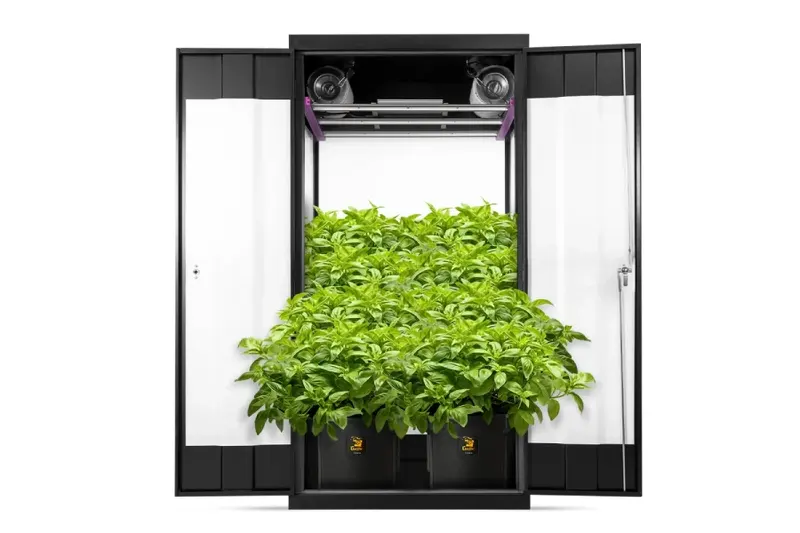
Grow Tents- Probably the most common among indoors growers, grow tents are increasingly convenient way of growing and housing your plants. Whether you need a place in your garage, somewhere in your room, or you need a tent the size of a whole room, you can likely find the tent you need to grow most any plant you can think of.
Tents come in a wide range of styles and sizes for any grower and nearly any plant.
With a tent there's no need to drill/mount hanging hooks or vents for lights and fans.
In tents you have control over grow environment than in most other setups.
Bonus: in the right setting, you can utilize light from the sun to supplement light when lights are out or dying
Greenhouse- When growing inside just won't happen but you don't have tons of room outside either, think about building or buying a greenhouse. In a greenhouse you get all of the benefits of growing outdoors (temp, abundance of light) with the added benefit of indoor growing (supplemental lighting and ventilation)
In a greenhouse you tend to save money on lighting by utilizing the sun’s light, which is actually one of the most optimum light sources available
In the event you need extra lighting you only need T5's or lower powered HID's to hold you over until the sun comes back out (though you can always use LED or high powered HID's, too)
There's also plant training techniques like Light Dep that help you get bigger plants in greenhouses
Because they're already partially acclimated to outdoor environments, you have the potential to take greenhouse-grown plants out of the green house and plant them directly outside without lots of training like you would bringing indoor plants outside
Choosing Your Medium (Soil/Hydro/Coco)
Once you have an idea of the strain you want to grow and where you want to grow it, now comes the stage of preparation that's probably the most important part: choosing the medium you want to grow in.
Your medium will determine how many nutrients you use, what type of nutrients you'll use, how you feed your plants, and how challenging correcting issues will be.
There are three popular grow mediums to choose from with their own advantages and disadvantages, so be sure you make the right decision before growing those plants:
Soil is the all-purpose medium. Most soil doesn't need much supplemental nutrition because it's already loaded with nutrients. Heck, if you mix up your own super soil you can even eliminate around 90% of supplemental nutrition and just use water for the majority of a plant's life.
Great for beginners, lots of buffer room in terms of feedings and readings.
Retains nutrients the of all mediums (Needs little nutrients when you start, and all you do is add a little when your plants need them).
Recommended Skill Level: Novice, Advanced, Professional.
Plants generally take longer to grow in soil.
Nutrient issues may not show up right away, and when they do it can be difficult to quickly fix (plants can get so sick in soil they’re beyond repair).
Unlike hydro where roots will hang down in bucket, soil roots go all over the place and if you don’t have enough room for those roots you’ll get root bound plants, and those are never good.
Hydroponics is an all-water soil-less way of growing medium. It's a lot less messy than dirt, and if you run in to nutrient problems they're much easier and faster to fix than soil problems. Hydroponic grown plants even take less time than soil plants to harvest.
Nutrients are absorbed much faster than in soil.
Hydro is usually faster growing than soil or coco.

Questions & discussion
Have a question or something useful to share? Start the conversation.