That’s why environmental controllers are such a live-saver. You just plug in all of your equipment, dial in your grow room's optimal environmental conditions, and let the controller take care of the rest.
Most controllers allow you to control the humidity and temperature of your grow room, but others can control a lot more like Co2 levels and some that can even adjust the pH and PPM levels of your water.
The Difference Between Readers, Controllers, and Timers
While timers and readers are used in auto controllers, it’s the controller that will eliminate a lot of the work needed to regulate the environment in your grow room.
A timer turns equipment on an off over a given length of time. You set the time you want an appliance to turn on and when to shut it off- simple enough, right?
Timers are good for applications like timing when lights shine or if you feed your plants at a certain time each day (like as soon as lights come on and right before they shut off).
A reader gives you the reading of a certain aspect of your growing environment, and there’s a huge range of them out there.
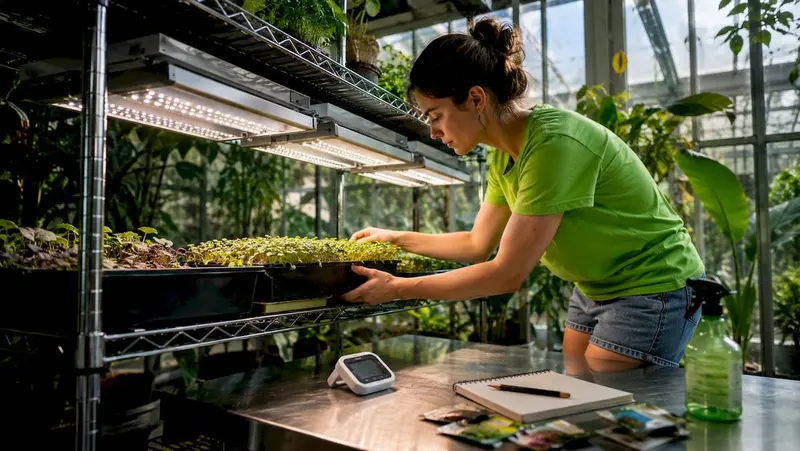
Your basic readers like thermometers and hydrometers read temperature and/or humidity levels in your growing space. Other readers can measure the moisture content of soil, moisture content in the air (humidity), Co2 levels in your grow room, the pH and PPM reading of your medium (like the one in this picture), and much more.
But reading conditions and timing equipment are only part of the battle- you have to make adjustments to the environment yourself. That’s unless you’ve got an automatic environmental controller that does it for you.
No matter what aspect(s) of your grow you plan on controlling, once you set the environmental thresholds for your grow room an automatic controller will help bring your grow room right where you need it to be consistent.
Single Purpose Environmental Controllers
Single purpose controllers are just that: controllers that serve one or two purposes.
Take, for example, heat mat temperature controllers. This helps to regulate the temperature of the heat mats you’re running to make sure your root zone gets the consistent temp it needs for a good root zone.
Another example of single purpose controllers are devices that can read the Co2 level of your grow room and emit Co2 when your garden needs it. There are even controllers like pH controllers that adjust and regulate the pH of your water by emitting pH Up or pH Down to bring levels back to where they need to be.
Day/Night controllers come in handy for beginners and professional growers. All you do is set the temperature you want during lights on (or during the "day") and lights off (or at "night"), and your equipment will turn on when temperatures reach a certain degree “at night” and “during the day”. They allow you to connect a heater, A/C, or fans to bring temperatures where they need to be.
These types of environmental controllers will take the stress out of adjusting part of your grow room's conditions, but just one of them. More advanced devices will let you connect both heating and cooling equipment to control temps all the time, which is awesome when it comes to temperature drops in the extremes of a season. When you have lots of elements in your grow room you want to control you're going to need a more advanced device...
Multi-Purpose Environmental Controllers
Now for growers with lots of equipment who want to control nearly every single aspect of their grow room, you’re going to want a multi-purpose grow room controller. While single-purpose devices will, for example, activate a dehumidifier to help humidity levels, a multi-purpose controller will help bring down humidity while regulating temperature and adjusting your plants PPM levels. Sound awesome? They are! Well, sort of…
From feeding your plants to making sure your grow room's nice and comfortable while they grow, multi-purpose controllers will do it all for you on your schedule. These do, however, pose a couple of challenges:
These controllers can be sort of complicated to use- If you're not familiar with recycling light cycles or how Co2 emitters work be ready to read up on them because the better the multi-purpose controller is the more (complicated) features it has.
If you're not familiar with crazy grow terms or equipment don't worry, there are still multi-purpose controllers that will do the basics: time your lights to turn on/off, regulate feeding pumps, and turn on heaters and A/C's when needed.
Making the use of this type of grow room controller- Multi-purpose controllers can be used in smaller grow rooms, but most who use them have lots of control. Be careful not to go overboard when choosing the right multi-purpose controller for you. How do you go about doing that?
Take a look at what you already have. Devices with 8+ ports are usually for grow rooms that have lots of equipment to run. Most growers will pick a controller based on what it can do, and not necessarily on what they need out of it, so if you’re going to spend a good amount of time and trust in a device make sure you get only what you need. If you’re on a smaller scale and don’t have equipment Co2 emitters or pH/PPM adjusters, you’ll find a 4 unit controller .


Questions & discussion
Have a question or something useful to share? Start the conversation.