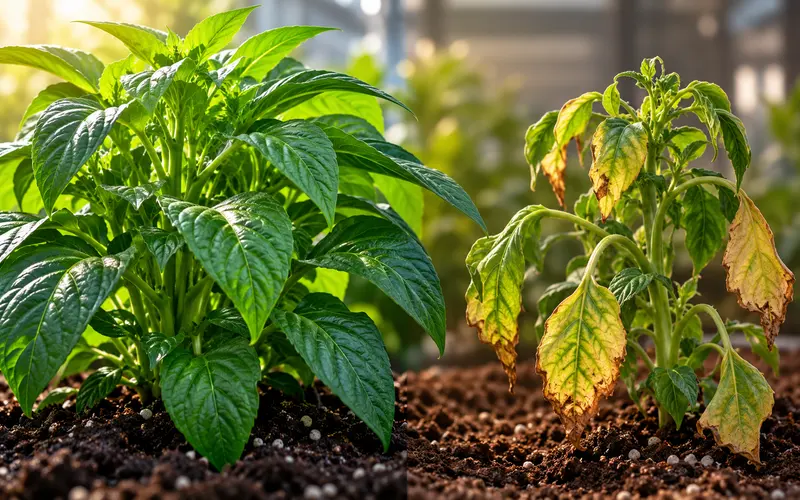
A nutrient problem does not always announce itself with yellow leaves, burned edges, or stunted growth.
In many cases, plants can continue looking reasonably healthy while nutrient uptake, root development, photosynthesis, flowering, fruit production, and overall growth are already operating below their potential.
That is what makes nutrient problems so frustrating.
You can use a high quality fertilizer, follow a feeding schedule carefully, and still lose performance because of pH drift, nutrient interactions, poor mixing, inaccurate measurements, or an irrigation system that is not delivering what you think it is.
The important thing to understand is that plant nutrition is not simply about how much fertilizer you add.
It is about whether those nutrients remain available, balanced, soluble, properly delivered, and accessible to the roots.
Below are five nutrient mistakes that can quietly reduce plant performance, along with practical ways to identify and prevent them.
Adding Too Many Nutrients and Supplements
More nutrients do not automatically produce more growth.
One of the easiest ways to complicate a feeding program is to keep adding products whenever a new problem appears.
A typical nutrient shelf can quickly fill with:
Each product may have a legitimate purpose.
The problem begins when several products start supplying the same elements or pushing individual nutrient levels far beyond what the plant actually needs.
Nutrients Can Compete With Each Other
Plant nutrients do not behave independently.
The concentration of one nutrient can affect how easily another nutrient is absorbed.
This is sometimes called nutrient antagonism.
Excess calcium interfering with magnesium uptake
High potassium reducing calcium and magnesium uptake
High phosphorus reducing zinc availability
High phosphorus affecting iron availability
Excess nitrogen affecting the availability of certain micronutrients
This creates an easy trap for growers.
A plant begins showing what appears to be a magnesium deficiency, so more magnesium is added.
But the plant may already have enough magnesium available.
The actual problem could be excessive calcium or potassium interfering with uptake.
Adding another supplement does not necessarily correct the imbalance. It can make the nutrient solution even harder to manage.
Keep the Feed Program Understandable
A good nutrient program should be complicated only when there is a clear reason for the complication.
If you are using numerous supplements, look at what each product actually contributes rather than relying only on the product name.
If three different products contain calcium, magnesium, phosphorus, or potassium, understand how much of each element is being added to the complete solution.
The goal is not to use the number of products.
The goal is to provide a balanced nutrient solution that the plant can consistently absorb.
Letting pH Drift Outside the Proper Range
You can have plenty of nutrients in the root zone and still end up with nutrient deficiencies.
One of the most common reasons is pH.
Nutrients must remain chemically available before roots can absorb them efficiently.
When pH moves too far outside an appropriate range, certain nutrients become significantly less available.
The nutrient may physically exist in the growing medium or nutrient solution, but the plant cannot access it efficiently.
At lower pH levels, plants can have more difficulty taking up nutrients such as calcium, magnesium, and potassium.
At higher pH levels, micronutrients including iron, manganese, zinc, and copper can become less available. Phosphorus availability can also become restricted.
That means a plant showing a deficiency does not necessarily need more fertilizer.
It may need the existing fertilizer to become available again.
Exact requirements vary by plant, fertilizer program, water source, and growing method, but common starting ranges include:
Hydroponic systems: approximately 5.5 to 6.5
Coco coir: approximately 5.7 to 6.3
The objective is not to obsess over maintaining one exact number every second of the day.
The more important goal is keeping the root zone within an appropriate range where the major nutrients and micronutrients remain available.
Do Not Assume Your pH Meter Is Correct
Owning a digital meter does not automatically mean your measurements are accurate.
A pH probe can gradually drift out of calibration, especially when it is used regularly.
Your readings can also be affected by:
Measuring before nutrients are thoroughly mixed
Testing from an unrepresentative part of the reservoir
Imagine your meter reads 5.9 while the actual solution is considerably different.
You may begin adjusting a nutrient solution that did not need adjusting in the first place.
Regular calibration is one of the simplest ways to avoid chasing problems that are really measurement errors.
A reservoir reading is useful, but it does not always tell you exactly what the roots are receiving.
Compare the pH at the reservoir with the pH reaching the plant.
Mixing Nutrients in the Wrong Order
Making a nutrient solution is not as simple as pouring several concentrated products into a reservoir.
Certain fertilizers can react with each other.
If those reactions occur before the products have been properly diluted, nutrients may form insoluble compounds that plants cannot easily use.
This process is known as precipitation.
What Nutrient Precipitation Looks Like
Precipitation happens when dissolved nutrients react and form solid material.
Common problem combinations can involve:
Calcium and concentrated phosphates
Calcium and improperly introduced silica products
Instead of remaining completely dissolved, some of the nutrients can fall out of solution.
This can leave residue in a reservoir or irrigation system.
Unless the manufacturer specifically says otherwise, concentrated nutrient products should generally not be mixed together before being added to water.
Continue according to the manufacturer's recommended mixing sequence.
This is particularly important with multi-part fertilizer systems.
Many manufacturers intentionally separate calcium and other reactive ingredients into different bottles specifically so they remain stable during storage.
Those components are designed to meet only after being sufficiently diluted.
Silica products deserve additional attention because certain formulations can significantly change solution pH and may react poorly with concentrated nutrients.
Follow the manufacturer's instructions for the specific silica product you are using.
Some products need to be diluted or added to the water before other nutrients.
Do not assume every silica supplement can simply be poured into an already concentrated nutrient mixture.
Treating the Leaf Instead of Diagnosing the System
Leaves are excellent warning indicators.
They are not always good diagnostic tools.
A yellow leaf can have multiple causes.
So can brown edges, interveinal chlorosis, curling, weak growth, or unusual coloration.
Similar Symptoms Can Have Different Causes
What looks like a nutrient deficiency may actually be caused by:
That is why immediately reaching for a deficiency chart can lead you in the wrong direction.
For example, adding more potassium because the leaf edges look like a potassium deficiency will not solve a problem caused by damaged roots or incorrect pH.
It may create another imbalance on top of the original problem.
When a nutrient problem appears, check the system before adding another product.
A practical troubleshooting sequence is:
Check EC or nutrient concentration.
Confirm irrigation is working correctly.
Check temperature, humidity, airflow, and other environmental conditions.
Only then investigate individual nutrient deficiencies.
This simple order can prevent a lot of unnecessary adjustments.
If your pH is substantially outside the appropriate range, correct that problem first.
If the root system is unhealthy, adding additional fertilizer may accomplish very little.
If irrigation is inconsistent, some plants may be receiving a completely different nutrient concentration than others.
Fix the system before changing the recipe.
Electrical conductivity, or EC, gives you a useful indication of the concentration of dissolved salts in a nutrient solution.
It does not tell you exactly which nutrients are present.
If your nutrient recipe normally produces a predictable EC and suddenly the reading is dramatically different, investigate why before making another adjustment.
EC is most useful when you understand what is normal for your particular system.
Consider Plant Tissue Testing for Persistent Problems
For home growers, careful observation combined with pH and EC measurements can solve many problems.
For larger or more advanced growing operations, plant tissue analysis can provide another level of information.
Tissue testing measures nutrients that have actually entered the plant.
A reservoir test tells you what you supplied.
Plant tissue analysis helps show what the plant absorbed.
Testing may identify nutrient deficiencies, excesses, or developing imbalances before the symptoms become severe.
It can be especially useful when the same unexplained problem repeatedly appears despite apparently correct pH, EC, irrigation, and environmental conditions.
Assuming Your Irrigation System Is Delivering Exactly What You Mixed
Automated irrigation can make a growing system much more consistent.
It can also create a false sense of precision.
A pump turning on does not necessarily mean every plant is receiving exactly what you intended.
Irrigation and fertigation equipment gradually wears.
Sensors drifting out of calibration
If a dosing pump is delivering slightly less fertilizer than expected, the plants may not immediately show dramatic symptoms.
But the difference can accumulate across weeks of growth.
One of the easiest tests is to compare what should be coming out of the irrigation system with what actually reaches the plants.
Collect solution directly from an emitter.
Compare those measurements with the nutrient solution at the reservoir or mixing station.


Questions & discussion
Have a question or something useful to share? Start the conversation.